July Retrospective: Back in July 2014, I wrote a daily series exploring the realities of navigating the creative economy. Twelve years later, looking back at these entries (and my original awful hand-drawn illustrations!), I’m struck by how the core truths of a creative career remain completely timeless. Each day this month, I’m opening up the archive to share these foundational lessons—with a few modern reflections layered in.
If you’re a new creative graduate looking to find your footing in the creative economy, a Gen X looking to pivot into a creative business, a side-hustler or someone who just wants to up their creative business game, there’s something for you in this series. Just don’t judge my drawings 😉
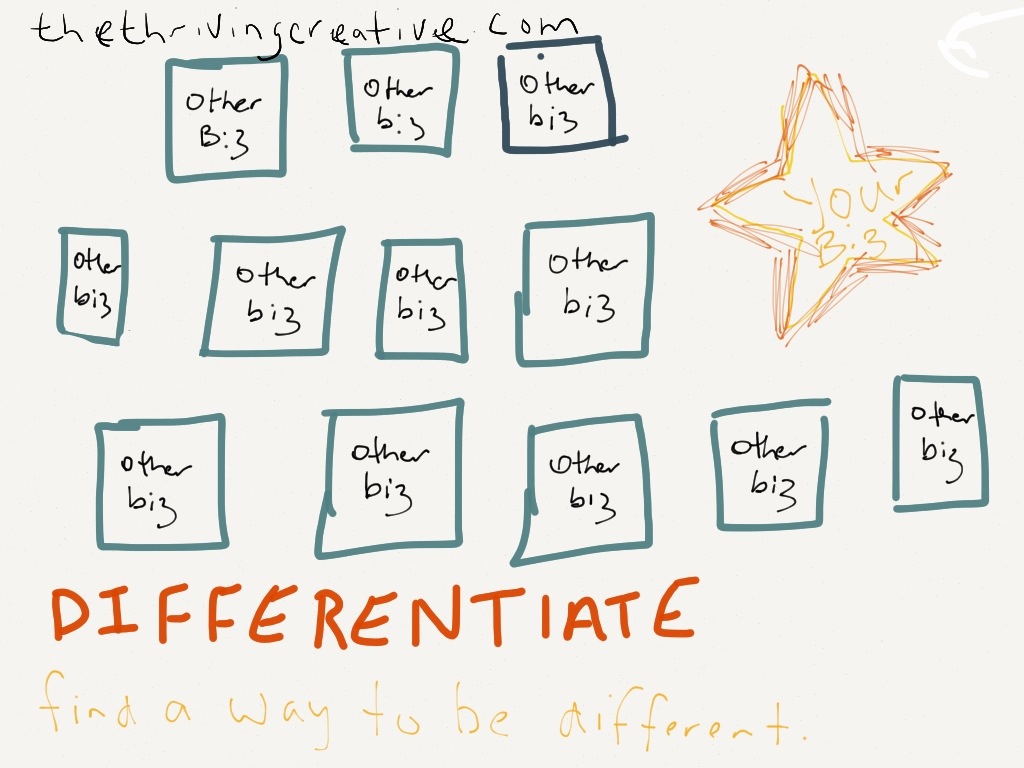
Differentiation & Positioning
Did you do your SWOT analysis (Day 4)?
If you haven’t yet, you might want to complete that first as it’s going to help you with what we are discussing today.
On day 3 we considered your competition. Chances are there are quite a few people selling goods or services similar to yours. As a consumer it can be hard to figure out who to buy from when there are a number of similar vendors.
It’s no good being like everyone else because it means that the only way you can compete with them is on price. Competing on price is never a good strategy as it just drives the price down to nothing. If you undercut your competition for the same product/service, there will always be someone willing to undercut you. This drives prices lower and lower until you go out of business because you can’t lower the price any more.
This is not a good strategy.
You want to use your SWOT analysis to figure out how to differentiate yourself in the market. You will use your strengths, your weaknesses, your opportunities and your threats to figure out the way you can present your goods/services that make it DIFFERENT to the competition. [Maybe my awful hand-drawn illustrations differentiate me in a market drowning in slick AI-generated images?] Figure out what makes your goods or services UNIQUE and you won’t struggle so much to find customers and make sales.
Positioning yourself within the market is about highlighting your differences. Figuring out what sets your goods or services apart from other SIMILAR but NOT THE SAME goods and services.
Until you do this, you will struggle. Generic products and services are incredibly difficult to market and to sell. If you have been trying to run a creative business offering the same things as everyone else, you will know how hard it is.
When you figure out what makes your work different, marketing becomes much easier because you can appeal to buyers who are looking for something unique.
This is also referred to as ‘finding your niche.’ Finding your niche is determining the one, tiny slice of the marketplace that you can properly serve – and this is determined by looking at what sets your goods or services apart from your competition.
Many people panic and say ‘but I’m not that different.’
Don’t look for massive differences. Even small differences give you something to market. Dig into your story and your history to find something unique.
Maybe you studied with someone famous? Or were raised in the wilds by wolves? Or you’ve moved halfway around the world? Or maybe you are totally boring and conventional but you turn that into a unique selling point! Use what you’ve got….
The more creative you can be means that just about anything from your SWOT analysis can be turned into a unique feature that will set you apart from your competition.
Action: Dig into your SWOT, take a look at your competition and figure out how you will differentiate yourself. How will you position yourself in your market so you are not competing head to head with someone else?
If you’re really stumped about how to differentiate yourself, use the comments box below to tell us about yourself – maybe we can help you brainstorm what sets you apart.
Longevity in a creative career isn’t accidental—it’s built on strategy.
While the landscape shifts, the core principles of thriving as a creative freelancer haven’t changed. For deeper, modern frameworks on building a sustainable creative practice:
- Read the Book: Looking for a step-by-step field guide to building a resilient career in the creative economy? Pick up my recent book The Thriving Creative: Successful Freelancing in the Creative Economy available from Amazon, Barnes and Noble, and from my publisher Routledge.
- Stay Connected: Join my community and to receive the complete 31-day hand-drawn playbook as a single PDF at the end of the month. Sign up below.

Leave a Reply