July Retrospective: Back in July 2014, I wrote a daily series exploring the realities of navigating the creative economy. Twelve years later, looking back at these entries (and my original awful hand-drawn illustrations!), I’m struck by how the core truths of a creative career remain completely timeless. Each day this month, I’m opening up the archive to share these foundational lessons—with a few modern reflections layered in.
If you’re a new creative graduate looking to find your footing in the creative economy, a Gen X looking to pivot into a creative business, a side-hustler or someone who just wants to up their creative business game, there’s something for you in this series. Just don’t judge my drawings 😉
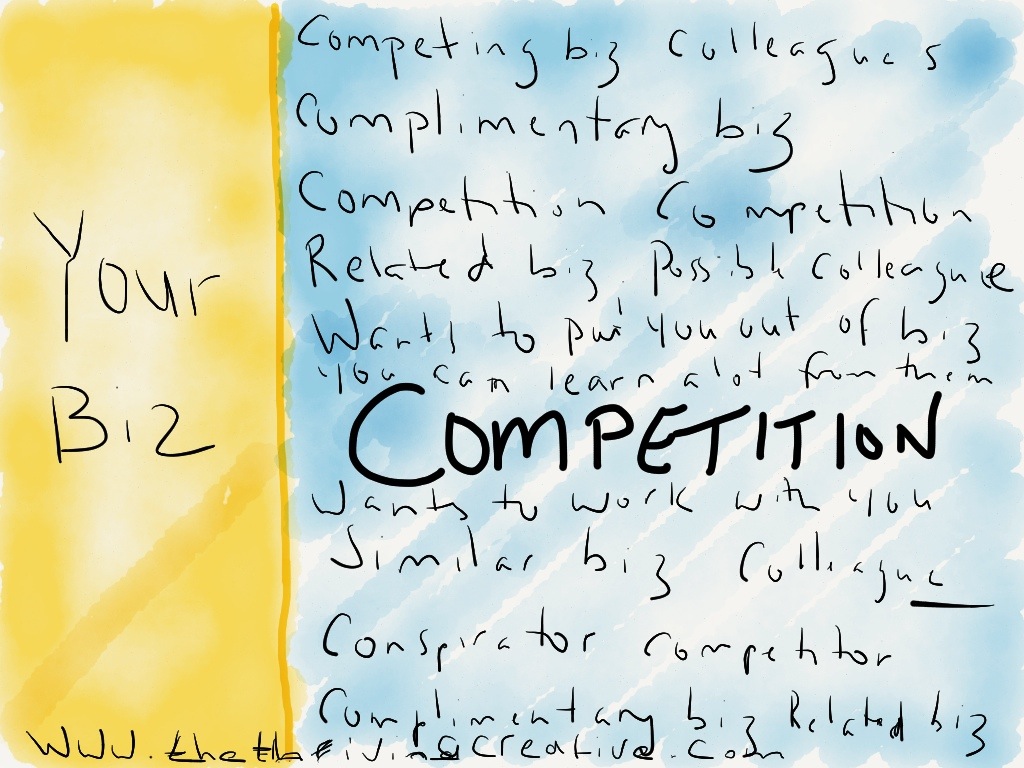
Competition
Once you know what you’re offering for sale you need to consider your competition.
Don’t be put off by your competition. You will always have competition and competition is healthy.
First off, it makes everyone better as you have to up your game to compete. Second, if there is no competition it probably means that the area you are seeking is not viable. If there was money to be made in that field then someone else would have got into it before. There is hardly anything that is new, so if you have no competition I would take that as a warning sign.
Also, if there is no competition, then it means you have to create demand for your product/service where it doesn’t exist – you are having to create a market which is both expensive and time consuming.
So if you find you have competition, or even lots of competition, that isn’t a bad thing. It tells you there are people who want what you are offering: a necessary thing for a healthy business.
You can learn a lot from your competition. You need to really understand them and their businesses. Don’t be overwhelmed and don’t allow yourself to start doubting what you have to offer. This is simply a research gathering exercise. You want to figure out who your strongest competitors are in your market.
If you are offering goods or services in a face to face market, then you want to consider the leaders in your geographic area.
If you are looking to sell online, then you need to acquaint yourself with the leaders in your field in the online sphere. Don’t be intimidated by those with flashy websites, millions of followers on socials or amazingly polished pitches. You are there to learn from them only.
Study them with a cool, analytical eye. Figure out what they are doing well and also what they are missing. Find their strengths and their weaknesses. Really understand WHAT they are offering and to WHOM they are pitching it.
Lastly, ask yourself what you can do that’s better than them.
Action: list your top five competitors. Next to each one write 3 things they do really well and 1 thing you can do better.
Got a question? Fire it into the message box below and I’ll try to answer it.
Do you know someone who would benefit from the July challenge? Why not send them an email and direct them here to join us!
Longevity in a creative career isn’t accidental—it’s built on strategy.
While the landscape shifts, the core principles of thriving as a creative freelancer haven’t changed. For deeper, modern frameworks on building a sustainable creative practice:
- Read the Book: Looking for a step-by-step field guide to building a resilient career in the creative economy? Pick up my recent book The Thriving Creative: Successful Freelancing in the Creative Economy available from Amazon, Barnes and Noble, and from my publisher Routledge.
- Stay Connected: Join my community and to receive the complete 31-day hand-drawn playbook as a single PDF at the end of the month. Sign up below.

Leave a Reply